The Foundational Text

Trevor J. Phillips' 1967 doctoral dissertation is the most thorough scholarly treatment of transactionalism as a tradition. For nearly fifty years it was inaccessible — typed on onion-skin paper, bound in a black library cover, deposited in the University of Connecticut archives. Influence Ecology located the manuscript, secured the rights, and published it in 2013, with foreword by Kirkland Tibbels and editorial work by Kirkland Tibbels and John Patterson.

This page presents the work: the foreword that frames its publication, the chapters in summary, the discipline that emerged from it, and the route to obtain a copy.

What is transactionalism?

The foreword was written in July 2014, from Ojai, California, when the published edition went to press. It is Kirkland Tibbels' account of the search that led to the dissertation's recovery — and his framing of why the publication mattered.

The search began in September 2009 with a question that should have been simple: What is transactionalism? The internet returned no introductory source. The literature returned dozens of disciplines using the term — anthropology to zoology, philosophy to political science, psychology to social anthropology — each operating with a working definition, none citing a foundational text. Names accumulated: Lang, Oerter, Pepper, Vygotsky, Piaget, Ames, Bruner, Smith, Simmel, Deutsch, Barth. Each illuminated some facet of the tradition. None defined it.

A breakthrough came through Rebecca Aldrich's article in the Journal of Occupational Science, which traced the lineage to John Dewey. Following Dewey forward led to Phillips' dissertation — a single text that did what no contemporary work had done: trace transactionalism from its philosophical and psychological origins to its present applications. A year of work through academic channels secured access to the original manuscript. Another year of work secured publication rights from Phillips himself, nearly fifty years after the dissertation was deposited.

"Transactionalism simply had no codified or single source of reference and yet, with very little exception, how the term had been described and explained remained fairly consistent across numerous landscapes of study." — Kirkland Tibbels, Foreword, 2014

The foreword closes with a hope: that the publication might "lead to an entirely new modern philosophy, or if not something so ambitious, perhaps a framework to ground our thinking and acting." That sentence, written in July 2014, was written before what came next. What came next is the subject of §5.

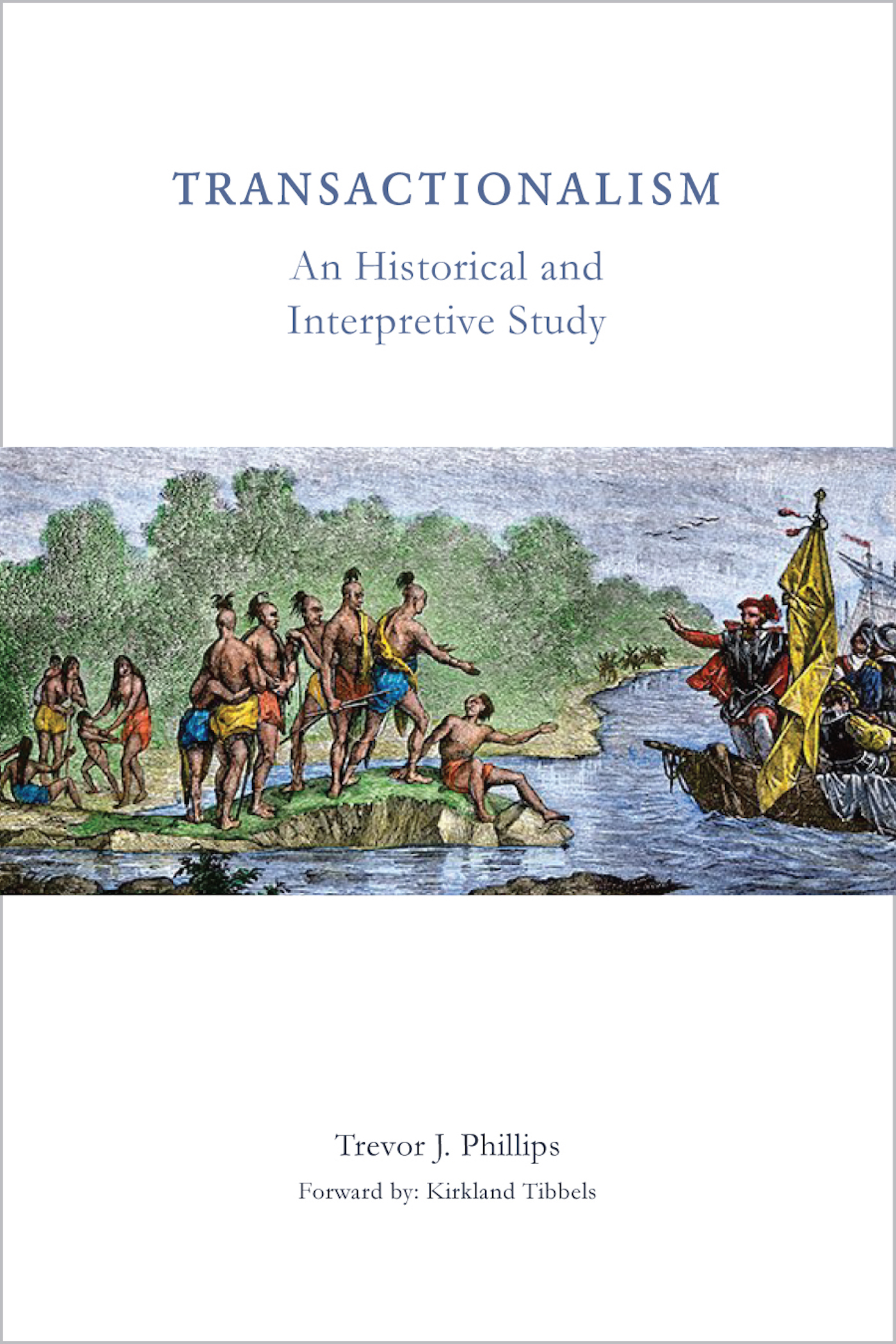
Transactionalism: An Historical and Interpretive Study by Trevor J. Phillips, published by Influence Ecology, 2013
Transactionalism: An Historical and Interpretive Study (Influence Ecology, 2013).

Trevor J. Phillips

Dr. Phillips is a former high school teacher and longtime professor of philosophy of education. From the beginning of his career he has been a student of John Dewey — the pragmatic approach and the application of Dewey's theories to democratic life. Transactionalism, in his account, was the culmination of Dewey's life's work and that of his contemporaries.

Phillips immigrated to Canada in 1947 from England. After several years teaching high school history, he moved with his young family to the United States to begin doctoral study at the University of Connecticut. The dissertation that became Transactionalism: An Historical and Interpretive Study was completed in 1967 under the direction of Dr. I. N. Thut, with associate advisors Dr. Glenn C. Atkyns, Dr. William T. Gruhn, and Dr. Sherman M. Stanage.

Phillips followed his doctorate with a thirty-three year tenure at Bowling Green State University, serving first as teaching professor and later as department chair. Upon retirement in 1995, he and his wife returned to Canada and settled in British Columbia. He has been associated for the past decade with Third Age Learning, a participatory learning program for adults over fifty sponsored by Kwantlen University, of which he is one of the original founders. He was also an early supporter of the program's Philosophers' Café.

Chapter Synopses

Each chapter is summarized in one paragraph, anchored by a representative quotation. The summaries do not substitute for the source. They orient a reader to what the dissertation does — and what it does not do.

Chapter I — Introduction

The opening chapter establishes the gap Phillips set out to fill: the absence of any systematic and comprehensive account of transactionalism as an intellectual movement, despite increasing reference to it across disciplines. The study, he writes, is a survey of the transactional movement from its philosophical and psychological origins to its present applications, with particular attention to its significance for education. Phillips situates transactionalism against idealism and realism — the dominant epistemological positions — and asserts that its central contribution is a re-orientation of how we understand human dignity, agency, and integration with environment.

"A review of the literature revealed a paucity of material pertaining to the history and interpretation of transactionalism." — Phillips, Ch. I

Chapter II — Transactionalism Viewed Historically

Phillips traces the term transaction from antiquity to the twentieth century. He documents the Greek historian Polybius (second century B.C.) using the word in a sense remarkably similar to its modern philosophical usage, then moves through Galileo's break with Aristotelian inherent-nature explanations, Newtonian mechanics, Maxwell's field theory, and the gradual emergence of process-and-context as the unit of scientific description. The chapter introduces Phillips' three-part typology — self-action, interaction, transaction — and traces the pragmatist line through Peirce, James, Mead, and the early Dewey. It closes with a preliminary philosophical definition.

"Transaction denotes a reciprocal relationship between that which acts and that which is acted upon. In this relationship, both become united for the moment in a mutual transition or 'transaction.' It is a process in which both are reciprocally transformed." — Phillips, Ch. II

Chapter III — Transactionalism in Contemporary Philosophy

The chapter develops contemporary transactional theory through a detailed treatment of Dewey and Bentley's Knowing and the Known (1949). Phillips works through the metaphysical position (the rejection of dualisms; the knower-and-known taken as one event), the epistemological tenets (truth as deliberately striven-for consequence; knowledge as transaction between observer and what is observed), and the field's contemporary corroboration in Niels Bohr's complementarity principle and Ludwig von Bertalanffy's general systems theory. The chapter closes with a numbered ten-point summary of the basic transactional tenets — the most concentrated statement of the philosophical position in the dissertation.

"From birth to death every human being is a Party, so that neither he nor anything done or suffered can possibly be understood when it is separated from the fact of participation in an extensive body of transactions." — John Dewey, quoted in Phillips, Ch. III

Chapter IV — Transactionalism in Contemporary Psychology

Phillips applies the transactional approach to psychology, opening with a survey of historical positions on human nature — Pre-Platonic animism, Platonic dualism, Aristotelian psyche-body unity, Cartesian bifurcation, Thorndike's behaviorist connectionism. Each represents a different answer to the question of what an organism is and how it perceives. The chapter then turns to the transactional alternative: a thoroughgoing rejection of the stimulus-response model, drawing on Dewey's 1896 reflex-arc essay and the Adelbert Ames perception studies. The chapter closes with a numbered nine-point summary of transactional psychology's tenets, anchored in the claim that perception itself is a transaction.

"Stimulus and response are verbal abstractions for a total situation involving a sentient organism and its environment as aspects of that situation." — Phillips, Ch. IV

Chapter V — The Educative Process

The final chapter applies the transactional view to education and learning. Phillips works through Dewey's philosophy of education — The Child and the Curriculum, Democracy and Education — and re-examines the learning process under transactional assumptions: a new model of human nature; the role of interest, purpose, and perception in experience; the rejection of knowledge-as-commodity in favor of knowledge-as-transaction. The chapter closes with an evaluation arguing that transactionalism, while compatible with Dewey's educational vision, requires a prior social shift to take hold in schools. Its final line proposes that the formulations of transactional philosophy and psychology may be the "thesis for a new development" within pragmatist thought.

"The 'thesis for a new development' which Aiken believed could be found within the synthesis of philosophic thought that is Deweyism, may well have found its expression in the formulations of philosophical transactionalism and the experimentations of transactional psychology." — Phillips, Ch. V (final line of the dissertation)
From Foundation to Discipline

The foreword was written in July 2014, before any of the work that has followed. Kirkland Tibbels closed it with a hope — that the publication might "lead to an entirely new modern philosophy, or if not something so ambitious, perhaps a framework to ground our thinking and acting."

What emerged in the years that followed was operationally larger than either possibility. Not a new philosophy — Phillips' dissertation had already established the philosophical ground that the tradition contained. What was needed, and what was built, was a methodology and discipline for navigating consequential exchange in the present tense: the structured exchanges on which careers, organizations, and livelihoods depend. Transactional Intelligence is what the philosophical tradition does when it is operationalized for commercial practice.

Phillips' dissertation is the foundation. TQ is what was built on it. They are distinct works — the foundation is philosophical and historical; the discipline is operational and contemporary. Neither replaces the other, and neither could exist without the other.

Kirkland Tibbels is currently formalizing the relationship between the tradition and the discipline in his doctoral dissertation, The Philosophy of Transactionalism and the Birth of Transactional Intelligence — a work in progress, advisor approved.

Transactionalism: An Historical and Interpretive Study

Trevor J. Phillips
Foreword by Kirkland Tibbels
Edited by John Patterson and Kirkland Tibbels

Influence Ecology, LLC, Ojai, California — 2013
ISBN 978-0-9904417-0-0
Library of Congress Control Number: 1-1006506061

Available on Amazon

All purchase links route to Amazon. The page itself does not transact. Press and academic inquiries about the publication may be routed through the press contact in the footer.

The intellectual lineage and the framework built on it are documented in full.